

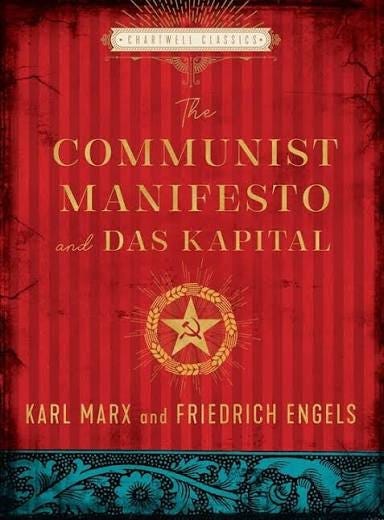
With the electoral rise of the DSA and the conversations churning around Marxism and Socialism, it’s worth noting that it turns out the original guy living off his parents and building a whole ideology to avoid getting a job predates the meme by about 190 years.
Before Karl Marx became the patron saint of every dorm-room revolutionary with a mommy-and-daddy-funded gap year, he was, by his own father’s account, a loser twentysomething who couldn’t manage an allowance.
Thanks for reading! Subscribe for free to receive new posts and support my work.
While studying at the Universities of Bonn and Berlin in the 1830s, Marx lived on a generous annual stipend from his father, Heinrich, a successful lawyer. A “nice middle-class income” at the time ran around 300 thalers a year. Even the richest students of the era, Heinrich wrote, spent under 500. Karl spent almost 700 – in a single year – on nothing his father could identify. “As if we were men of wealth,” Heinrich wrote to his son, “my Herr Son disposed in one year of almost 700 talers contrary to all agreement, contrary to all usage, whereas the richest spend less than 500.” He wasn’t calling his son a common thief or wastrel, exactly: “I do him the justice of saying that he is no rake, no squanderer,” Heinrich allowed, but sounded like a father who has run out of angrier words to try. Heinrich Marx was calling out something else, something more contemporary-sounding: a young man who treated his family’s money as an ambient resource, always there, never worth tracking, an entitlement rather than a gift.
The overspending wasn’t a one-time youthful stumble. Karl ran up debts during his student years that required his father to step in and pay them off directly, on the condition that Karl transfer to the more “sedate” University of Berlin – a 19th-century version of Dad-calling-the-dean. When Karl, in the midst of all this, wrote home describing himself as “torn” and unhappy, Heinrich’s patience finally cracked in a letter that reads like it could’ve been posted to a subreddit about entitled adult children today: “I hate this modern expression – ‘torn’ – used by weaklings if they are disgusted with life merely because they cannot get without effort beautifully furnished palaces, elegant carriages, and millions in the bank.” Translated out of 1830s German syntax: stop being sad that you can’t have everything for free, and go get a #*%!ing job.
Marx never really did. Heinrich died in 1838, and with him went the allowance, the safety net, and – not incidentally – the parent most inclined to actually confront his son about money. Marx’s biography for the next four decades is a long, unbroken record of financial dependency, just redirected onto new benefactors: occasional inheritances from his mother’s side (money she reportedly tried to steer toward paying off his creditors directly, having presumably learned something from her husband’s letters), and above all, the lifelong, extensive financial support of Friedrich Engels – heir to a family that owned textile factories, which is to say: the actual capitalist enterprise Marx spent his career theorizing should be overthrown, quietly bankrolling the theorist for most of his adult life.
It’s worth remembering this origin story now, because the ideology it produced hasn’t exactly stayed in the 19th century. The Democratic Socialists of America has grown from a graying debate club of a few thousand members a decade ago into an organization north of 120,000, with more than 250 members holding elected office nationwide as of this year – including a sitting member of Congress and a big-city mayor. Marx’s core complaint, dressed up in updated vocabulary, is still the engine: someone else’s productive labor is owed to you, and resenting the people who built it is a political program rather than a personality flaw. It worked out well enough for its founder to get 2,500 pages and a beard on a coffee mug. It’s still working, a century and a half later, on people who’ve never once had to explain a 700-thaler bar tab to their father.
There’s a version of this story that’s been sanded down by a century and a half of ideological reverence into something noble: the penniless philosopher, exiled and impoverished, sacrificing material comfort for the sake of the working class. But behind the scenery of the mythology the actual documentary record (read: reality) reveals his own father’s letters – preserved and archived, not by hostile critics but by Marxist archivists themselves – and a far less flattering throughline. Here was a young man who never developed the ordinary adult competency of living within his means, who treated the wealth generated by his family’s actual productive labor as an entitlement rather than a resource, who was rescued from the consequences of his own spending again and again by people who loved him, and who spent the rest of his life being subsidized by the son of a factory owner while writing that factory owners were the problem.
It is the ultimate irony that the philosophy that indicted the bourgeoisie for extracting unearned value from other people’s labor was authored, funded, and sustained almost entirely by unearned value extracted from other people’s labor: his father’s law practice, his mother’s inheritance, and Friedrich Engels’ factories. Marx didn’t escape the system he criticized… he never stopped needing it to carry him. He just never learned to say thank you for it, and instead wrote 2,500 pages arguing that the people paying his bills were the villains of history.
A central tenet of capitalism is that reward follows hard work; what you put into building something is what you ought to get out of it. Since Marx wasn’t too crazy about the building or working part, but still felt he was entitled to reap the benefits of other people’s hard work, shouldn’t that disqualify Das Kapital and Marx himself from weighing in on something to which he was so overtly averse? Is he really their best mascot?
Every dorm-room revolutionary hanging a Marx poster next to their unpaid parking tickets and their parents’ Venmo requests should probably know the man they’re quoting invented an entire theory of history rather than just get a job – and somehow made it look like your fault for noticing. So the next time someone tells you to read Das Kapital as a defense for why Democratic Socialism is a thing, or quotes Marx at you from the couch their parents are still paying for, remind them: the original freeloader already tried this. He just had better branding.
Thanks for reading! Subscribe for free to receive new posts and support my work.
Sofia is a patriot polymath contributor. She travels with the First Fleet, and I am in a rowboat. She is also a Brownstone author and an activist in California who worked closely with publisher Tony Lyons and Robert F. Kennedy Jr on several projects, including Kennedy’s best-selling book: The Real Anthony Fauci. She collaborates with several organizations in the legal, legislative, medical science, and literary spaces, and she is co-founder of Spirit of 1776, which is building strategic infrastructure for the course correction in the form of fortifying human protections against interventions of all kinds and, under that tent, building the parallel alternatives for communities to thrive.
Sofia is a co-founder of Free Now Foundation, a non-profit preserving medical freedom and children’s health, the creator and host of the Patriot Network news show 4th Branch, the founder and treasurer of the Common Sense SuperPAC which supported Robert Kennedy’s bid for President, and the founder and current treasurer of the Decentralize America PAC, which focuses on legislative and judicial initiatives, grassroots lobbying, and supporting common sense candidates in both state and federal elections who focus on winding back corporate capture and corruption at all levels of government.
Subscribe to her HERE to get more content like this.
In his personal life Marx was an execrable human being.
Marx was controlled opposition working for the banker/merchant class.
Here's a long read detailing that in excruciating detail:
https://mileswmathis.com/marx.pdf
Some speculate the Russian revolution was engineered by agents of the wealthy because they feared the size and power of Russia.
And some quotes:
Remember kids, when the communist people take power, they always become a capitalist government. All of Soviet Russias production and means of production was seized by the government rationed out in starvation amounts to it's people, and the CCP take 90% of their peoples wealth and leave them in squalor. As soon as the people become the government, communism fails. On the alternative, as soon as capitalist leaders take hold in the government, the corporations become regulatory bodies and stack the system against the poor, and capitalism becomes a corporatocracy, and fails.
It's almost as if the problem isn't a matter of communism, socialism, or capitalism, which are all excellent human behaviors, but is actually the gross centralization of authority, and enforcement of specific behaviors as economic ideologies that we idolize as if they were some kind of broken, artificial gods.
Samuel Streeter