

READER RESOURCES: All my books are now available as paperbacks on Lulu. THE APOCALYPSE ALMANAC: Hidden cures in our dystopian age. Check out the “Cure Cancer in Your Kitchen” chapter. FULLSCRIPT SUPPLEMENTS: top quality and economical. AFFILIATE STORE: I offer competitively priced products HERE that I have personally tested and used.
Summary
• Ben Bathen, a friend who has stayed in my home, was prescribed Lexapro (escitalopram) by a clinician who followed a psychologist’s instructions. He developed akathisia, the drug-induced inner torment that drives suicide and violence, became enraged, made a phone call, and spent 2 years in a San Diego County jail. He was cut off his drugs without a taper. He now has involuntary movements and jaw clenching that is destroying his teeth.
• Every court that reviewed his case refused to consider whether the drug caused his behavior. A state judge called his condition “voluntary drug use.” A federal judge called his genetic test results “speculation.”
• David Carmichael, whom I have also met in person, killed his 11-year-old son in 2004 after raising his Paxil (paroxetine) dose. A Canadian court found him not criminally responsible, held him about 5 years, and released him. He has been off all psychiatric drugs since 2010.
• Ben’s website, WrongfulSSRIConvictions.com, documents the political money behind the judges who ruled on his case. The dollar figures come from public records. The inference that money bought the rulings is his, and I explain below why I think the mechanism is worse than a bribe.
• These drugs are addictive. Withdrawal lasts months, sometimes years, and some patients who have taken them for years cannot stop at all because their brains have adapted to the drug. Ben was forced off his in a jail cell.
• No psychiatric drug has ever been tested against a true placebo in patients who were not withdrawing from a similar drug. The “placebo” groups were in withdrawal, which made the drugs look better and safer than they are.
• The evidence that these drugs cause suicide and violence has been in company files since the 1980s and in the FDA’s own database for decades. Both were kept from the public until litigation pried them loose. Lexapro’s maker pleaded guilty to a felony in 2010, and its discovery file stayed sealed until 2018.
• The reactions are not rare. In the maker’s own Prozac trials, the drug produced new agitation in 1 patient in 5 over placebo. Bruxism, the jaw clenching that is destroying Ben’s teeth, has the strongest link to antidepressants of any movement disorder in the World Health Organization’s database.
• American prescribers hand out these drugs after a 5-minute checklist. I did it myself about 1,000 times. The damage lands on the patient, and the courts make sure it stays there.
Ben
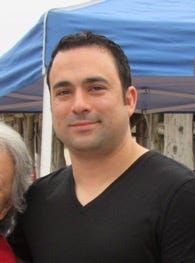
Benjamin Lee Bathen. Photograph from WrongfulSSRIConvictions.com, used with his permission.
I have known Ben Bathen for several years. He stayed at my house. He is soft-spoken and careful, and since his release, he has spent years building a public archive of what happened to him and others like him. He gave me permission to tell his story, and his own account and documents are at WrongfulSSRIConvictions.com.
A prescriber put Ben on Lexapro (escitalopram). From what Ben has told me, the prescriber did whatever a treating psychologist said to do and understood little about the drug. Ben developed akathisia. The word means an inability to sit still, but that understates it. Patients describe a relentless inner torment, a feeling of crawling out of their own skin, and it is the symptom most often found behind SSRI suicides and violence. Stewart Dolin, whose story is below, was last seen pacing a train platform before he stepped in front of the train.
With the akathisia came uncontrolled anger, which is a known effect of this drug class that nobody had warned Ben about. He was out of state when he telephoned the psychologist in a rage. They told him to come back to California, and when he did, they arrested him.
San Diego County convicted him in 2017 of making a criminal threat. No one was touched. He served 2 years.
In custody, his medications were abruptly stopped without a taper. Anyone who has watched a patient come off an SSRI abruptly knows what that means: electric-shock sensations, insomnia, agitation, nausea, and a return of every symptom the drug was supposed to treat, only worse. In a jail cell, with no one who understood what was happening, he was forced to endure it. When he came out, he had involuntary movements that look to me like tardive dyskinesia. He also has bruxism, the grinding and clenching of the jaw, so severe that it is wearing his teeth down. Dentists have little to offer for it.
Comment: Both of these problems are on the record for SSRIs. The manufacturers list bruxism and movement disorders in their own labeling, and the 2017 Frontiers in Psychiatry review I cited in Butchered by “Healthcare” linked the class to akathisia and tardive dyskinesia. Abrupt withdrawal makes movement disorders more likely to appear or to persist. If a jail physician added an antipsychotic to control his agitation, which is routine, the odds of a permanent movement disorder rise further. I have not seen his jail medication records, so that part is inference.
Addiction by another name
“Prozac is not addictive,” the package label says, and every SSRI label since has repeated it. The claim rests on a technicality: there is no opioid-type craving. What there is, in a large fraction of patients, is a withdrawal syndrome that begins within days of a missed dose and that the companies renamed “discontinuation syndrome” so no one would use the other word. The Federal Trade Commission received many consumer complaints about the non-addictive claim. It changed nothing.
The withdrawal mimics the disease. When a patient stops the drug and develops anxiety, insomnia, agitation, and despair, his doctor sees his depression returning and restarts the medication. That is what I did for years. Nearly every prescriber does. The symptoms are proof of brain alteration, and the observer reads them as proof the drug was working. Once a patient starts, this loop keeps most people on the drugs indefinitely.
The severity is beyond anything the labels describe. Stuart Shipko, a California psychiatrist who has spent decades helping patients get off these drugs, tells them the medications are neurotoxic rather than addictive, because that is the more accurate word. He says that quitting after short-term use is often possible. After years of use, it is typically agonizing and sometimes futile. Some patients deteriorate, and a few become psychotic. A severe reaction such as chronic, unremitting restlessness sometimes begins up to 6 months after the last dose. Tapering, when it works, takes up to 2 and a half years, usually with a compounding pharmacy making progressively weaker pills.
Tapering does not always work. Some people who have taken these drugs for a decade or more cannot come off them at any rate of reduction. Their brains have remodeled around the drug, and every attempt ends in a collapse that sends them back. For them, the damage is permanent, and the only remaining choice is which set of symptoms to live with. The withdrawal stories on survivingantidepressants.org run for years. Opioid withdrawal is a week of misery. This goes on for months, and for some, it never ends.
Ben got none of this. He got a jail cell and a cold stop. Whatever the drug had done to his brain in the months before his arrest, the withdrawal finished the job.
Ben later had his liver enzymes tested. A OneOme RightMed panel found reduced function in CYP2C19 (a *1/*3 genotype) and in CYP2D6 and CYP3A4. Escitalopram is cleared mainly by CYP2C19. A patient with reduced enzyme function gets a higher blood level from an ordinary dose, and the consortium that writes dosing guidelines for these drugs calls for lower doses when CYP2C19 function is reduced. Nobody tested Ben before prescribing. Nobody tests anyone. The panel costs a few hundred dollars, and the drug is handed out by the tens of millions of prescriptions.
What the courts did with it
Ben filed a habeas petition arguing that his lawyers never raised the drug and that he was involuntarily intoxicated by a prescribed medication he had no reason to distrust. San Diego Superior Court Judge Timothy R. Walsh denied it on May 6, 2020. According to Ben’s account of the ruling, the judge described his condition as “voluntary drug use.” The Court of Appeal denied his petition on July 13, 2020 (case D077657). Federal District Judge Michael M. Anello denied federal habeas relief and a certificate of appealability on October 5, 2021, in Bathen v. Allison (20-cv-2063), and in Ben’s account called the genetic test results “speculation.”
The word “voluntary” is doing all the work here. Under California law, voluntary intoxication is no defense. Involuntary intoxication, which includes an unexpected reaction to a prescribed medication taken as directed, is a complete defense. The entire case turns on whether a man who swallows a pill his doctor gave him, and who was never told it makes some people violent, has done something voluntary. The courts said yes. They said it without a hearing on the evidence.
Ben’s documents also describe the prosecution’s expert. The psychologist who directed his treatment, Carolyn Francis Jacobs, Psy.D., testified against him at trial. Ben’s exhibits show that the district attorney paid her $325 an hour under contract. As a treating psychologist personally affected by the case, she had a clear conflict of interest. His trial and pretrial lawyers, by his account, never subpoenaed her clinical or billing files and never put the drug in front of the jury. This is the ineffective-assistance claim the courts refused to hear.
Two other California cases followed the same path. Laura Wenke, convicted of attempted murder after a 2011 stabbing while on Lexapro, sued Forest Laboratories and Allergan and lost; the Ninth Circuit affirmed on January 7, 2020. Simon Ranteesi, convicted of a 2002 killing while on Paxil, lost an involuntary-intoxication instruction claim in 2009 and later claims in 2014 on procedural grounds. In none of the three did a court find that the medication caused the violence. In none of the three did a court examine the question.
The money behind the bench
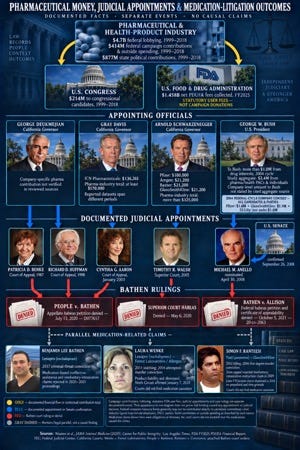
Documented money, documented appointments, and the Bathen rulings. Sources listed on the graphic.
Ben’s website documents something the mainstream press rarely assembles in one place: the political money that flowed to the officials who appointed the judges who ruled on his case. I checked the federal lobbying and violence-report figures below against the original papers. The California contribution figures are from Ben’s archive, which cites state filings and press reports.
The Wouters study in JAMA Internal Medicine (2020) found that the pharmaceutical and health-product industry spent $4.7 billion on federal lobbying from 1999 to 2018, $414 million on federal campaign contributions and outside spending, and $877 million on state political contributions. Of the federal money, $214 million went to congressional candidates. The FDA, which writes the drug labels the courts defer to, collected $1.458 billion in net user fees from the companies it regulates in fiscal 2025 alone. That figure is conservative. Counting every fee the companies pay, the industry supplies over half of the money the FDA spends reviewing its products, and the agency has depended on that money since 1992.
Governor Arnold Schwarzenegger appointed Judge Walsh to the San Diego bench in 2005. Walsh had been a deputy district attorney and chief of staff to District Attorney Bonnie Dumanis, the office that later prosecuted Ben. In 2004, Pfizer gave $100,000 to a Schwarzenegger fundraising committee. Amgen, Baxter, and GlaxoSmithKline each gave $21,200. In 2005, the industry spent more than $53 million in California to pass its own Proposition 78 and defeat Proposition 79. Pfizer, GlaxoSmithKline, and Merck each put in nearly $10 million, and Eli Lilly close to $4 million.
President George W. Bush nominated Judge Anello on April 30, 2008, and the Senate confirmed him on September 26, 2008. Bush was the top federal recipient of drug-industry money in the 2004 cycle, taking in more than $1 million from drug interests. Pfizer gave $1.6 million to federal candidates and parties that cycle, GlaxoSmithKline $1.1 million, and Eli Lilly a little under $1 million.
Ben draws a straight line from these numbers to his cell. His words: the companies “bought the compliance of the Schwarzenegger administration, which in turn appointed defensive, corporate-aligned prosecutors like Timothy R. Walsh to the bench.” That is his inference, and I have set out the documented facts separately so a reader can decide for himself.
Comment: I think Ben’s diagnosis is right and his mechanism is too simple. No one had to bribe Judge Walsh. The system does not need a bribe. It needs a drug label written by the manufacturer, an FDA that gets most of its budget from the industry, a psychiatric guild trained on company-funded studies, and a judiciary that treats all three as authoritative. A judge who reads the Lexapro label sees a safe drug with rare side effects. He sees a defendant who “chose” to take it. He has never heard of CYP2C19, and neither has the public defender. The money at the top produces the ignorance at the bottom, and the ignorance is what convicts. That is worse than corruption. Corruption ends when the corrupt man leaves office. This does not.
What the companies knew and when
The evidence that these drugs cause suicide and violence is old. I laid it out in Butchered by “Healthcare” and summarize it here.
Start with the trials, because everything the courts rely on flows from them. A proper drug trial compares patients who take the drug with patients who take a sugar pill, and the sugar-pill patients have nothing in their systems. Psychiatric drug trials have never been run that way. The subjects recruited for them are, almost without exception, already on a psychiatric drug. They take it off, undergo a brief “washout” of a few days to a week, and then are randomized. The ones assigned to placebo are not drug-free. They are in withdrawal, with the akathisia, anxiety, insomnia, and suicidal thinking that withdrawal produces. The new drug, which relieves the withdrawal, looks like it treats the disease. The placebo group’s suffering gets recorded as the disease’s natural course, and the trial reports that the drug had fewer side effects than the sugar pill, which is absurd.
No SSRI, antipsychotic, stimulant, or benzodiazepine has ever been tested against a true placebo in subjects who were not withdrawing from a similar drug. The rest of the study machinery is what I described in the FDA chapters of Butchered by “Healthcare”: negative trials go in a drawer, positive ones get published several times under different names, and an old comparator drug gets given at a huge dose so the new one’s side effects look mild. The companies have internal nicknames for these tricks. German regulators read Prozac’s original data and called the drug “totally unsuitable for the treatment of depression” before they were pressured into approving it. The trials that put these drugs on the market are the same trials the FDA label rests on, and the label is what Judge Walsh read.
In 1985, before Prozac (fluoxetine) was approved, an Eli Lilly internal memorandum recorded that suicides on the drug were 5.6 times higher than on imipramine, an older antidepressant. Lilly executives wrote that they would “go down the tubes if we lose Prozac.” Their policy was to settle and seal lawsuits. By 2000 they had spent about $50 million on those settlements and called it “relatively insignificant.” In the drug’s first 9 years on the market, from 1988 to 1996, the FDA received 39,000 complaints, a record for any drug.
David Healy, the psychiatrist who wrote Let Them Eat Prozac (2004) and Pharmageddon (2012), believed the company line until he read the internal documents as a plaintiff’s expert. He then gave Prozac to 20 healthy volunteers with no depression. 2 of the 20 developed severe suicidal thinking that faded after the drug was stopped. A New Zealand study of 1,829 people on SSRIs found suicidal thinking in 39 percent. The FDA added a black-box suicide warning for children and adolescents in October 2004 and extended it to young adults in 2006. It has never added one for violence toward others.
In 2010, Thomas Moore, Joseph Glenmullen, and Curt Furberg published an analysis of the FDA’s adverse-event database in PLoS ONE. They identified 31 drugs disproportionately linked to reports of violence toward others. Antidepressants dominated the list. Prozac had a reporting ratio of 10.9, and Paxil 10.3, meaning violence was reported about 10 times more often with these drugs than with other drugs. Chantix (varenicline), the smoking-cessation drug, topped the list.
The company files on Lexapro stayed sealed longer. On September 15, 2010, Forest Laboratories, the maker of Celexa (citalopram) and Lexapro, pleaded guilty in federal court to a felony count of obstructing justice and 2 misdemeanor counts of distributing misbranded and unapproved drugs. It paid more than $313 million, with over $60 million of that going to the states whose Medicaid programs it had defrauded. The Department of Justice charged that Forest had promoted the one positive adolescent Celexa study it had, MD-18, while hiding a European study, number 94404, that found no benefit and serious suicide and violence signals.
The discovery record from the civil litigation that followed, In re Celexa and Lexapro Marketing and Sales Practices, cataloged as MDL 2067, went under a federal protective seal. Forest fought to keep it there. The plaintiffs’ lawyers got it unsealed, and on January 24, 2018, they handed 79 exhibits to the United States Attorney in Boston with a memorandum saying the fraud went deeper than the government had known when it took the plea. The exhibits showed that MD-18 had been compromised: 9 patients received pink commercial tablets instead of white blinded ones; Forest told the FDA it would exclude them, and then quietly put them back in to get a positive result. A Forest regulatory manager wrote in an internal email that part of her job was to create “masterful euphemisms to protect Medical and Marketing.” Joseph Glenmullen, the Harvard psychiatrist who coauthored the 2010 violence study, wrote the expert report that laid the record out.
The sealed record and the published trials show these reactions are not rare. Eli Lilly’s own early Prozac data, disclosed in 2005 after the documents went missing from a court file, showed that 38 percent of patients on the drug reported new activation against 19 percent on placebo, so the drug itself produced agitation in about 1 patient in 5. In randomized SSRI trials, about 5 percent of patients drop out because of agitation and akathisia, against 0.5 percent on placebo, a tenfold difference that David Healy and his colleagues documented in 2006. In children and adolescents, activation rates in placebo-controlled trials run from about 2 percent to 50 percent depending on the study, and one fluvoxamine trial found it in 45 percent of treated children against 4 percent on placebo. The published reviews of SSRI movement disorders put akathisia first, ahead of dystonia, parkinsonism, and tardive dyskinesia.
The prescribers do not see most of this. In a 2009 survey of about 700 patients on the 5 leading SSRIs, 38 percent reported a side effect, and only 40 percent of those ever mentioned it to the doctor who wrote the prescription. A 2004 study that interviewed patients directly found 86 percent had at least 1 side effect and their physicians underestimated every one of the 17 it asked about. The largest analysis of the World Health Organization’s pharmacovigilance database, published in 2020, identified 29,253 movement-disorder reports linked to antidepressants and found raised odds for every subtype it examined: akathisia, tardive dyskinesia, dystonia, myoclonus, parkinsonism, tremor, restless legs, tics, and bruxism. Bruxism had the strongest association of all, about 10 times the rate seen with other drugs. That is the condition that is destroying Ben’s teeth.
The FDA’s own detailed narratives of Lexapro-associated homicides came out only after Andrew Thibault sued the agency under the Freedom of Information Act in 2015. Ben has posted 149 pages of those scans, organized by case.
A few examples from the FDA’s files, as Ben transcribed them: a mother reported that her son, who “had never been in a fight or been violent at all until these drugs,” poisoned his best friend after Lexapro was added to Effexor. A forensic psychiatrist reported that “at the time the patient committed the murder he was taking escitalopram.” An ex-wife reported violent rages, blackouts, and a murder involving a 43-year-old man on the drug who turned himself in 2 weeks later. A parent reported that a young man shot himself in the head within days of being switched from brand-name Lexapro to a generic.
Ben’s archive is careful about these, and so am I. Several of the reporting physicians did not believe the drug was responsible. Several case numbers describe the same person. Some of the reports involve other drugs. A single report proves nothing. What the reports establish is that the agency had homicide narratives in its files for a decade and a half, that a private citizen had to sue to get them, and that no one told Ben’s prescriber, his lawyers, or his judges.
The reports have not stopped. From May 7, 2020, the day after Judge Walsh’s ruling, through June 30, 2026, the FDA’s public database received 4,514 reports involving Lexapro that were flagged as involving death, 838 completed suicides, 1,220 suicide attempts, 263 reports of aggression, and 39 of homicidal ideation. Prozac and Wellbutrin (bupropion) show similar figures. These are reports, not adjudicated cases, and the FDA itself estimates that only a small fraction of adverse events are ever reported.
Comment: The SSRI manufacturers have known all of this since their first studies.
Stewart Dolin
Stewart Dolin was a 57-year-old Chicago lawyer, a partner at a large firm, happily married to his high school sweetheart, with 2 grown children who adored him. He loved his work, travel, and skiing. Nothing about his life troubled the people who knew him except a brief episode of anxiety and low mood over work in 2010. He mentioned it to his best friend, a physician, who wrote him a prescription for generic Paxil (paroxetine). The friend, like nearly every doctor practicing in this era of concealment, had no idea that the drug drives some healthy men to kill themselves.
Six days later, Stewart walked to a downtown train platform. Witnesses saw him pacing back and forth, the classic picture of akathisia, before he stepped in front of an oncoming train. No note, no warning, no history. This is the signature of SSRI suicide: it arrives almost without antecedent, in people whose lives were going well, within days or weeks of starting the drug or changing the dose. The families are left explaining to police and coroners that nothing was wrong.
Paxil has the worst reputation in the class, and it has earned it. It was the drug David Carmichael was taking when he killed his son. In the 2010 violence study, it had a reporting ratio of 10.3. In 2004, New York Attorney General Eliot Spitzer sued GlaxoSmithKline after internal documents showed the company knew about Paxil’s tendency to cause suicide and had buried the pediatric data. The manufacturer had been quietly settling suicide cases for two decades while telling doctors the drug was safe.
Wendy Dolin sued. Testimony at trial established that GlaxoSmithKline had hidden Paxil-related suicides during and after the approval process, and David Healy, who had believed the company line until he read those documents as her expert, changed his position on the drug. In April 2017 a Chicago jury awarded her $3 million. Her lawyers had spent about $1 million to get there. The Seventh Circuit reversed in 2018, holding that GlaxoSmithKline was not liable for a generic and that the FDA had once declined a stronger warning. Wendy was not suing for money. She founded MISSD, the Medication-Induced Suicide Prevention and Education Foundation in Memory of Stewart Dolin, to teach the public what akathisia looks like, and she is still at it.
The foundation’s materials are the warning that Stewart, David, and Ben never received. Its tip sheet and clinician brochure describe the symptom in plain words: an inner restlessness that will not let a person sit, stand, or lie still, pacing, a sense of crawling out of one’s skin, terror or rage that arrives from nowhere, and sudden thoughts of suicide or violence, all appearing within days of starting a drug or changing a dose. Its free one-hour course, Akathisia 101, is aimed at nurses, social workers, and families, since the prescribers have shown little interest. Its video, Akathisia: In Their Own Words, lets sufferers and bereaved parents describe it themselves. Every prescriber in America should have to sit through that hour before writing the next prescription, and none of them will.
David Carmichael
His story is the worst I have heard in my career, and I have heard many. I interviewed him on my podcast in 2022, shared a stage with him in Santa Monica that October, and have been in contact with him since. He tells his own story at Mad in America, and I covered it in an earlier post.
He was a physical activity and sport consultant in Toronto with a wife and two children. In July 2003, at 44, worried about money, he lost weight, shook in the shower, and stopped sleeping. His family doctor gave him Paxil (paroxetine) without explaining side effects. He had suicidal thoughts the first week. They passed, and he weaned himself off in early 2004. When the sleep problems returned in July 2004, he put himself back on 40 mg, felt suicidal again within days, and raised the dose to 60 mg on July 16, reasoning that 2 aspirin work better than 1.
Three days later, he planned his suicide. Then he planned a murder-suicide. Then he planned a murder. On July 31, 2004, in a hotel room in London, Ontario, he killed his 11-year-old son Ian by smothering him with a pillow. He believed, with the fixed certainty of a delusion, that Ian had permanent brain damage from mild epilepsy, that Ian was in a living hell from schoolyard teasing, that Ian would kill his sister, and that taking Ian’s life and spending 25 years in prison was an act of love. The autopsy found nothing wrong with Ian’s brain. The delusions held for about 2 weeks after he stopped the drug, and then dissolved.
Two forensic psychiatrists, one for each side, diagnosed major depression with psychotic episodes, and the court found him not criminally responsible on account of a mental disorder. Paxil was never part of his defense. His lawyer told him causation would be nearly impossible to prove, and that even if they proved it, Canadian law put prescribed drugs in the same intoxication section of the Criminal Code as illicit ones, so the best outcome was manslaughter. He was held in the forensic system for about 5 years, and the review board released him after weighing the record. He has been off all psychiatric drugs since 2010 and has had no mental disorder since. In 2011, he sued GlaxoSmithKline.
The Canadian pharmacists’ reference listed delusions and psychosis as rare Paxil effects, about 1 in 1,000, at least as far back as 1996. The manufacturer supplied that entry. A 1-in-1,000 risk across tens of millions of prescriptions is tens of thousands of psychotic patients, and the company knew it before David’s doctor wrote the script.
Several friends who know both stories have told me the same thing: if David had done this in the United States, he would never have gotten out. But the Canadian board looked at the documentation and believed him. Ben threatened someone over the telephone, harmed no one, and has never gotten an American court to look at his documentation at all. One man lost his son and has his freedom. The other lost 2 years and his teeth, and the courts will not read his file.
Comment: America is so bought off by the pharmaceutical companies that they control all the narratives.
Prescribers
I have no standing to sneer at Ben’s prescriber. I wrote about 1,000 SSRI prescriptions over my career, screened patients with a few questions, and believed Peter Kramer’s propaganda, Listening to Prozac. When my patients stopped the drugs and fell apart, I told them it was their disease returning and that they should stay on the medication. I was repeating what I had been taught, and what I had been taught was written by the companies.
Ben’s prescriber did the same thing one level down. A psychologist, who cannot prescribe, stated what she wanted, and the clinician with the prescription pad wrote it. Neither tested his liver enzymes. Neither warned him about akathisia, rage, or withdrawal. Neither followed up when the anger began. When the drug did what its own label says it does, the psychologist became the prosecution’s paid witness.
About 1 American in 8 has been sold on taking an antidepressant by some jackass in a white coat. Primary care doctors, nurse practitioners, and physician assistants hand out the drugs like jelly beans after a checklist screening process that takes less than 15 minutes. Ben was not warned. David was not warned. The mother of a 12-year-old girl who died by suicide 3 weeks after starting Prozac wrote on Substack that her daughter’s psychiatrist never mentioned the black-box warning. Few prescribers know what CYP2C19 is. The system that trained them and the system that judged Ben are the same system, and the money at the top of this essay paid for both.
Synthesis
Ben Bathen’s website makes two claims. The first is that the money is documented, and it is. Billions in lobbying, hundreds of millions in contributions, judges appointed by the politicians who took the money, and rulings that protected the product. The second is that the money caused the rulings. I think the truth is less direct and more dangerous. The money bought the science, the labels, the guidelines, and the expert class. The judges did not need to be bought. They needed only to defer to what the money had already built, and they did and still do.
The evidence that SSRIs cause suicide and violence has been in company files for 40 years and in the FDA’s for 20. Both fought to keep it sealed. Lilly settled and sealed. Forest sealed its pediatric studies until 2018. The FDA, which is a creature of the pharmaceutical companies because its revenues are over half directly from them in user fees, fought a FOIA suit over its homicide narratives. During all of that time, prescribers kept writing, patients kept taking, and courts kept convicting.
David Carmichael was delusional on 60 mg of Paxil and killed his own son. A Canadian review board believed him and released him. Ben Bathen, who made a telephone call, served 2 years and has never had a hearing on the evidence. These men’s integrity is impeccable. The American courts have not been asked to believe Ben. They have been asked only to look, and they refuse.
Casual prescription of these drugs is unconscionable. None of them have undergone adequate trials with proper controls. Each study has compared them with people going through unpleasant and prolonged withdrawal from similar drugs, which proves nothing except the severely addictive quality of this class of medicines. Their withdrawals go on for many months and make opioid withdrawals seem like a walk in the park.
The presence of SSRIs and the other related psychiatric drugs on the market is a fraudulent outrage, an affront to every physician who’s working, and a mortal hazard to anyone who steps into a doctor’s office. I described all this in 2020, and Ben’s case is the footnote. Until a court somewhere in this country admits a liver-enzyme gene test and an FDA narrative file into evidence and lets a jury weigh them, every patient who reacts badly to a “psychiatric” drug his doctor gave him is on his own.
Selected references
• Benjamin Bathen, WrongfulSSRIConvictions.com, commentary and source archive, including the FDA narrative scans and case rulings.
• Wouters OJ, Lobbying Expenditures and Campaign Contributions by the Pharmaceutical and Health Product Industry in the United States, 1999-2018, JAMA Internal Medicine 2020.
• Moore TJ, Glenmullen J, Furberg CD, Prescription Drugs Associated with Reports of Violence Towards Others, PLoS ONE 2010.
• David Carmichael, Calm, Organized, Homicidal Behaviour: My Connection to School Shooters, Mad in America, 2018.
• Robert Yoho, David Carmichael’s tragedy was the worst I’ve ever heard, Surviving Healthcare.
• Robert Yoho, Butchered by “Healthcare” (2020), Part III, free download.
• SSRIstories.org, thousands of news accounts of violence and suicide on antidepressants.
• U.S. Department of Justice, Drug Maker Forest Pleads Guilty; To Pay More Than $313 Million, September 15, 2010; Wisner Baum, Celexa and Lexapro consumer fraud litigation, with the unsealed exhibits and Glenmullen expert report.
• Healy D, Herxheimer A, Menkes DB, Antidepressants and Violence: Problems at the Interface of Medicine and Law, PLoS Medicine 2006.
• Revet A et al., Antidepressants and movement disorders: a postmarketing study in the world pharmacovigilance database, BMC Psychiatry 2020.
• Cascade E, Kalali AH, Kennedy SH, “Real-World Data on SSRI Antidepressant Side Effects,”, Psychiatry (Edgmont) 2009; Hu XH et al., Incidence and Duration of Side Effects and Those Rated as Bothersome With SSRI Treatment, Journal of Clinical Psychiatry 2004.
• FDA Adverse Event Reporting System, openFDA.
• Wendy Dolin, MISSD, the akathisia education foundation named for Stewart Dolin; Dolin v. GlaxoSmithKline, Seventh Circuit opinion, August 22, 2018.
• SurvivingAntidepressants.org, peer support and withdrawal accounts.
• David Healy, Let Them Eat Prozac (2004) and Pharmageddon (2012).
• Peter Gøtzsche, Deadly Psychiatry and Organised Denial (2015) and Mental Health Survival Kit(2020).
• Robert Whitaker, Anatomy of an Epidemic (2010).
Ben’s entire document is here:

Everything above is history and argument. The section below is for the reader who is on one of these drugs, loves someone who is, or has received the phone call Ben’s family got. It is behind the paywall because it is the part that took 10 years to learn.